

Toe Cap FAQs
NO Toe Caps – Learn about increasing the longevity of your climbing shoes
We love providing high quality resoles for our customers.
Our goal is to reduce the need for toe cap replacements!
We prefer NOT to replace toe caps.
Although eliminating the need for toecaps altogether would be impossible because we know things happen – like sharp features at Smith Rock tearing through fresh rubber on a new shoe (total bummer!). We want to save you money and increase the life of your wonderfully fitting shoes!
The toe cap is the layer of rubber above the climbing rubber. The climbing rubber is the rubber below the seam where it meets the rand rubber, which is the rubber on the top side of the shoe. When you notice the seam starting to disappear or showing waves, you are starting to climb on the rand.
Look at the rubber on top of your toe; that’s the rand rubber. See how thin it is? When you have no more “climbing rubber” to climb on, you start putting all your weight on that extremely thin layer. Ouch! And yes, you’ll pop a hole quickly!
If your climbing rubber was left on the last route you did and you’re now down to the rand, you might not necessarily have a hole. However, there could still be weakness, and a hole is about to happen!
There are several factors that cobblers consider when replacing the toe rubber (toe caps) on your climbing shoes. The most obvious one is the presence of a hole in the rubber. However, it’s not always easy to detect. Reasons why a cobbler might replace the rand include having more than two resoles, the rand delaminating from the leather, or the original rand rubber not holding the new resole.
When cobblers inspect your shoes, they also feel the rand rubber. If they find any weak spots, that will develop a hole before needing a resole, they’ll replace the toe cap.
We want your newly resoled shoes to last you for multiple months before needing another resoling.
You can always request that we don’t replace the toe caps. However, please be aware that if you make this request, it will void the warranty on your shoes.
It’s not always obvious when a toecap is needed. We will evaluate the rands; if it’s more than halfway worn, we will replace them.
If there is a weakness around the seam where the rand meets the layer of climbing rubber, then it may need a new cap. When we start to work on your shoes, we lightly grind down the rand to prep it for the glue. If the rand is not stable enough, then it will have to be replaced. Deducing if a toecap is needed before the toe is opened up is difficult to do without a lot of experience in shoe repair. If you have further questions, feel free to email us pictures of your shoes.
No – the rand terminates about ¼” under the sole. The sole has to be removed in order for us to replace the rand rubber. So if we do toe caps, we must also do resole. Toe dragging is the most common cause for needing rand repair before a resole is recommended. It can be an effective technique for getting through those dicey moves – but expensive!
Because although it may look the same, rand rubber is not designed to take the stress of your weight against the rock. We get many (many, many!) folks who come in and say that one moment their shoes looked fine and then BAM! – a blown rand.
Our cobblers have had many years in the business and even they can’t absolutely determine the condition of the rand until they pull off the layer on top of your rand (your sole). Sometimes what you can see looks fine, but it is weak underneath. The last thing you (and we) want is for you to pay for shipping and resoling only to get your shoes back and have them blow in a month.
No, the answer is to get your shoes resoled when that layer of climbing rubber starts to disappear. The majority of shoes we get need toe caps, and the majority of the folks waited as long as possible because they wanted to keep climbing. Which we get! We strongly suggest you have 2 pairs of shoes, so one can get the care it needs while you continue to climb like a demon. Taking good care of 2 pairs of shoes will save you money in the long run. And please send in both shoes of the pair when one looks like it needs resoling. You don’t want one foot jealous of the other because it has nice, new rubber!
That is the rubber you are climbing on, vs the rubber on the bottom of your street shoes. Your street shoes are like your Honda, durable and designed to last for a loooong time, years hopefully. Your climbing shoes are darn expensive to begin with and expensive to maintain. The rubber is sticky and is actually meant to come off on the rock – that is how you stick so well! So if you get 6 months out of your climbing rubber while training like a mad person – then you are doing some pretty awesome delicate footwork!
Yes, we have a sewing machine for shoes. We generally stitch up the weakness in the lacing area of the Miuras at no charge.
If you need additional stitching, please indicate it and we will charge you accordingly. If you need extensive work, the charge could vary.

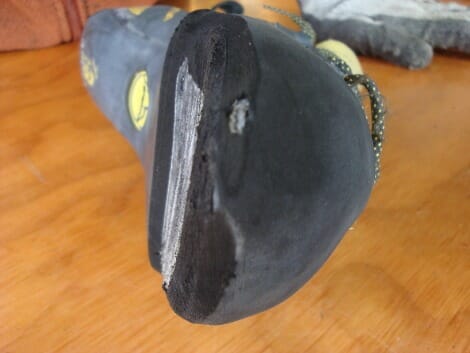
This photo shows how the rand wraps under the sole of the shoe. So doing a toe cap (replacing the damaged part of the rand) requires a half-resole.

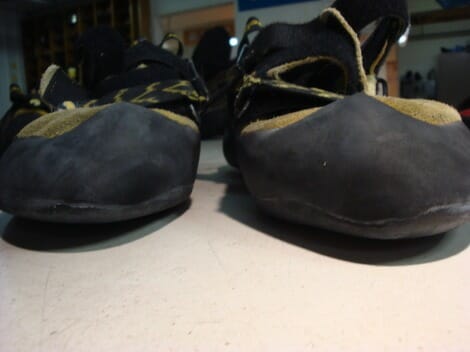
The shoe on the left is a bit beyond the need for a resole. The shoe on the right is coming in at a good time, while there is still sole rubber to climb on, rather than climbing on the rand.